
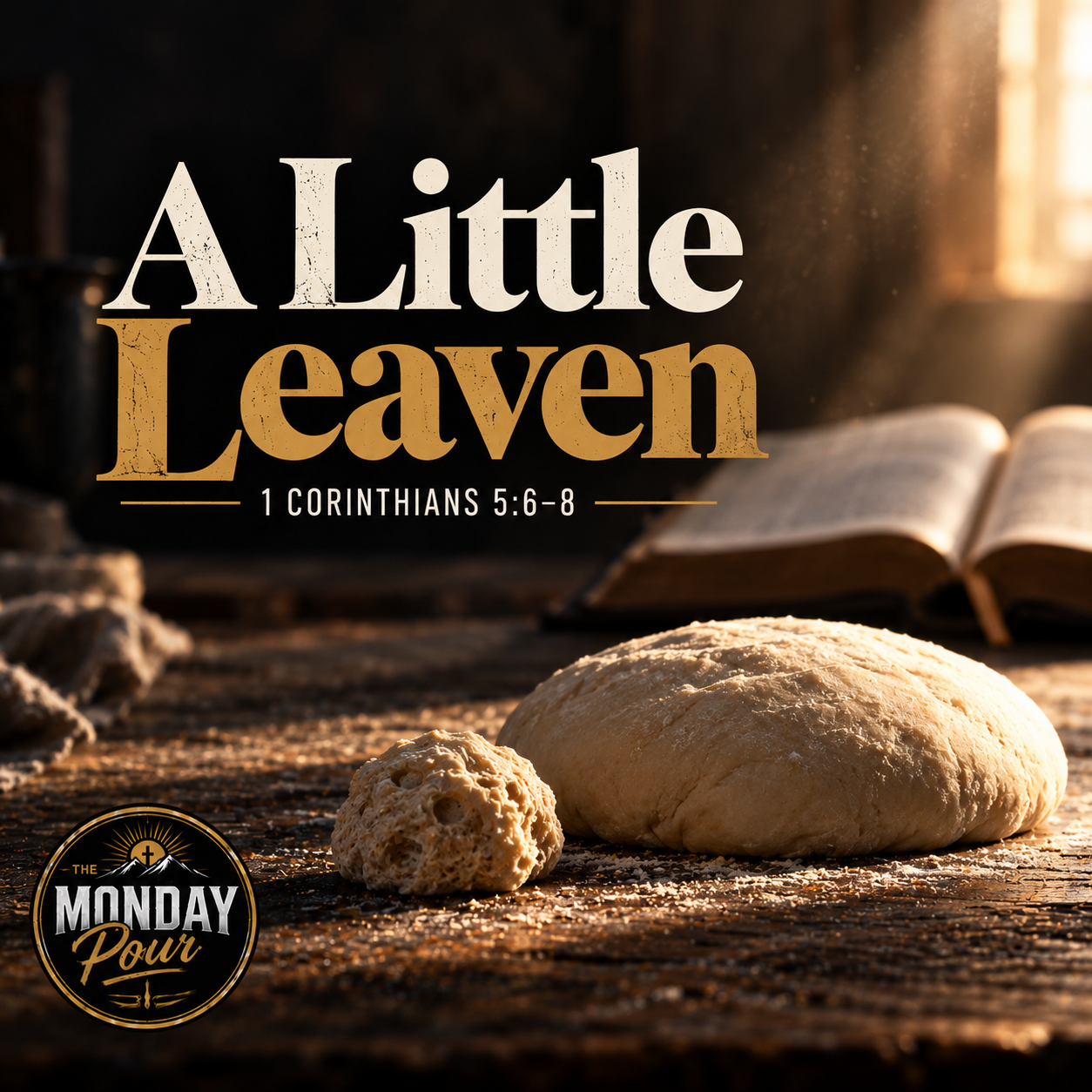
A Reflection on 1 Corinthians 5:6–8
Scripture: 1 Corinthians 5:6–8 (ESV)
Your boasting is not good. Do you not know that a little leaven leavens the whole lump? Cleanse out the old leaven that you may be a new lump, as you really are unleavened. For Christ, our Passover lamb, has been sacrificed. Let us therefore celebrate the festival, not with the old leaven, the leaven of malice and evil, but with the unleavened bread of sincerity and truth.
Reflection
It doesn’t take much leaven to change a whole batch of dough. That is the picture Paul gives the Corinthian church, and it is a simple one that carries a weight I don’t think we can afford to ignore. A little leaven works its way through the whole lump, often without drawing attention to itself. You don’t have to see it happening for the effect to be real. Paul is writing to a church that has allowed serious, public sin to remain among them without responding as they should, and their boasting has become part of the problem. They seem to have lost sight of the seriousness of what is happening in their midst. During Passover, the Jewish people were to remove leaven from their homes, and Paul draws on that familiar picture to remind the church that sin is not something to welcome, minimize, or learn to live alongside. The issue isn’t simply one man’s behavior anymore. It is also what that behavior is doing to the community that has allowed it to continue. And as I sit with this passage, I have to ask myself a question that is much easier to ask about someone else: where have I allowed a little leaven into my own life?
I know how easy it is to make room for something that should have been confronted. Sometimes it begins with a decision that doesn’t seem all that serious. Maybe I tell myself it is a small compromise, a private struggle, or something I can deal with later. Maybe I know something needs to change, but I am not ready to give it up, so I find a way to make it sound less concerning than it really is. Over time, what once bothered me may stop bothering me quite so much. I become familiar with it, and familiarity can quietly dull my sensitivity to what is true and what is false, what is good and what is destructive. That is one of the dangers of sin: it doesn’t always announce that it is taking over. Sometimes it simply becomes part of the furniture. I learn how to work around it, explain it, and keep it out of sight. Before long, I may not even recognize how much it has shaped my thinking or influenced the way I treat the people around me. What began as something I thought I could contain may have already worked its way into my relationships, my choices, and the example I am setting for others.
Paul is specifically addressing the church and the way its tolerance of open, unrepentant sin affects the congregation as a whole. We shouldn’t lose that context by turning this passage into nothing more than a lesson about private habits. The church is a body, and what happens within it matters. If sin is openly practiced and left unaddressed, it can begin to shape what the community accepts as normal. People may start to question whether the truth they have been taught really matters, or they may simply learn to look the other way because addressing the problem feels too uncomfortable. Either way, the church risks losing its clarity about the life Christ has called it to live. But that same principle makes me consider the people closest to me. What happens when I downplay sin in my own life? How does it affect my family, my friendships, and the men who may be watching how I live? What am I teaching through the things I excuse, the compromises I protect, or the conversations I refuse to have? I may think a particular choice belongs only to me, but my life is never as isolated as I would like to believe. The things I allow to grow in the dark can eventually affect the people standing in the light beside me.
There is another part of this passage that I don’t want to miss. Paul doesn’t simply tell the church to clean out the old leaven; he reminds them of who they already are because of what Christ has done. “For Christ, our Passover lamb, has been sacrificed.” That is the foundation of the whole argument. The call to live differently is not a demand that we make ourselves worthy of Jesus through better behavior. Christ has already given Himself for us. Our obedience grows out of what He has done, not out of an attempt to earn what we could never earn. Paul calls the church to put away the old leaven because, in Christ, they are already a new people. There is a difference between trying to become acceptable to God through our own efforts and learning to live in the new life He has given us. I need that reminder because it is easy to turn the pursuit of holiness into another project of self-improvement, something I can measure and use to convince myself that I am doing well. But the question isn’t whether I can make myself look clean. The question is whether I am willing to let Christ bring the truth into every part of my life and teach me to live as someone who belongs to Him.
That brings me to a word I keep returning to: eradication. To eradicate something is to pull it out by the roots. It means going deeper than trimming back what is visible or making a few changes that leave the real problem untouched. If I want to deal honestly with sin, I have to be willing to let God show me what is underneath it. What am I trying to satisfy? What am I afraid to lose? What hurt, insecurity, desire, or lie am I protecting by continuing to make the same choice? I can focus on the outward behavior while leaving the deeper issue untouched, and then wonder why I keep returning to the same place. I need more than the ability to recognize that something is wrong; I need the humility to bring it into the light and allow God to work in the places I would rather keep hidden. That kind of honesty can be uncomfortable, because it asks me to stop managing appearances and start telling the truth. It also asks me to take practical steps, whether that means confessing, setting boundaries, seeking counsel, or inviting someone trustworthy to walk with me through the struggle. Repentance is not simply feeling bad about what I have done. It is turning toward God and being willing to follow Him in a different direction.
I don’t believe we were created to do that work alone. We were created by the triune God, who has eternally existed in the perfect fellowship of Father, Son, and Holy Spirit, and we were made for relationship with Him and with one another. Yet we often live as though isolation is the safest way to protect ourselves. We tell ourselves that if someone really knew us, they wouldn’t love us, so we keep certain parts of our lives carefully guarded. We let people see what we want them to see, and we hide the places where we feel the most ashamed. Sometimes we even carry that same guardedness into our relationship with God, as though we could keep Him at a distance from the thoughts and desires we don’t want to examine. But who am I trying to fool? God already knows what is there. My secrecy does not protect me from His knowledge; it only keeps me from honestly bringing my struggles before Him and receiving the help He provides. And while human accountability is not a replacement for our relationship with God, a trustworthy brother or sister can help us recognize the lies we have started believing and remind us of the truth when our own thinking becomes clouded. We need people who can know us honestly, pray with us, ask difficult questions, and continue walking beside us as we learn to live faithfully. Not everyone needs access to every detail of our lives, but each of us needs relationships where honesty is possible and accountability is real.
As I write that, I can feel the tension between the man I say I want to be and the thoughts that sometimes rise up when I consider who God might be calling me to become. I think about the gifts He has given me, the opportunities to lead and serve, the men I may be able to encourage, and the ways my own experiences might help someone else. I think about being a son of God, a redeemed man, a leader, a truth teller, a helper, and a man who lives with purpose. Then another voice seems to answer: No, you won’t. You’re thinking too big. You can’t handle what is coming. Give up. He doesn’t see you like that. Those thoughts can feel convincing, especially when they touch places where I have struggled to believe in myself. But I have to learn to examine those voices rather than automatically accept them as truth. I don’t have to pretend I am capable of everything, and I don’t have to assume every ambition I have is a calling from God. I do need to return to what He has actually said about those who belong to Christ. My identity is not built on my accomplishments, my influence, or the opinions people have held about me. It rests in the grace of the One who has redeemed me and is continuing to renew my mind. I can be honest about my weaknesses without agreeing with every lie that tells me my weaknesses are the whole story.
Maybe this is where the picture of the leaven comes together for me. The hidden things I allow to shape my heart matter, but so does the truth I allow to shape it. If I continually feed my flesh, entertain lies, and protect the things that keep me from surrender, those things will influence the man I become and the people around me. But if I feed my soul with God’s Word, bring my sin into the light, and walk in honest community, I am making room for truth to shape the way I live. I cannot control every outcome, and I cannot become the man God has called me to be through willpower alone. But I can choose to stop defending what He is asking me to surrender. I can offer the gifts He has given me to others instead of using them to build a name for myself. I can live from the identity Christ has given me rather than remaining captive to names and labels that were never meant to define me. The call is not merely to do more for God. It is to become more deeply rooted in the truth of who I am in Him, so that what flows out of my life is shaped by His presence rather than by the things I have kept hidden. I want to live with sincerity and truth, not just speak those words. And I want to be willing to let God keep digging, even when He reaches a root I would rather leave alone.
A Prayer for Today
Papa,
What do You want me to know today? What do You want me to do? Show me where I have minimized sin, justified my choices, or allowed something into my life that is slowly shaping me in ways I don’t recognize. Don’t let me become so comfortable with my compromises that I lose my sensitivity to Your truth. Give me the courage to confess even the things that seem small, because I know that what I leave unaddressed can grow deeper roots than I realize. Help me stop trimming the branches while protecting the root. Search my heart, expose what needs to come into the light, and give me the willingness to take the next step toward repentance.
Feed my soul so I can feed others, and teach me to feed my flesh less. Bring trustworthy people into my life who will know me honestly, pray for me, challenge me when I need it, and remind me of Your truth when I begin to believe the lies. Help me stop living a guarded life, pretending I can hide anything from You or manage my life better than You can. Teach me to trust You with my deepest longings, my fears, my weaknesses, and the parts of my story I would rather keep hidden. Give me the humility to receive help and the courage to offer that same kind of honest brotherhood to others.
Father, remind me who I am in Christ. When the old names and familiar lies rise up, help me recognize them for what they are instead of allowing them to direct my life. Keep me grounded in Your truth. Let me live as Your son, a redeemed man who can use the gifts You have given him to serve others and advance Your Kingdom. Keep me from confusing who I am with what I accomplish. Help me understand that I am called not only to do Your work but to walk closely with You, allowing You to shape the man doing it.
Christ, my Passover Lamb, thank You for giving Yourself for me. Because of Your sacrifice, I don’t have to hide behind shame or pretend that I have everything together. I can confess, repent, receive Your grace, and keep walking with You. Make my life one of sincerity and truth. Help me lay down my kingdom, my flesh, my desires, and every counterfeit identity that competes with the truth You have spoken over me. I want to be who You have called me to be, not simply look like the man I think others expect me to be.
I surrender my heart to Yours. Let the truth of Your Word shape me from the inside out, and let the gifts You have placed in me become a blessing to the people You put in my path.
Amen.
Reflection Questions
- Where have I minimized or justified a sin because I don’t want to face the changes repentance requires?
- How might my choices be affecting my family, friends, church, or the people who look to me for leadership?
- Have I become desensitized to something that Scripture clearly calls me to take seriously?
- What might it look like to address the root of a recurring struggle rather than only its outward symptoms?
- Is there a trustworthy person who knows me well enough to ask difficult questions and hold me accountable?
- What names, labels, or lies have I allowed to shape my identity more than what God says is true of those who belong to Christ?
- Am I focusing more on what I do for God than on who I am becoming as I walk with Him?
Final Thought
A little leaven can work its way through the whole lump, but hidden sin is not the only thing that can shape a life. Truth can take root, too. Bring what is hidden into the light, let God reach the roots, and stop living under names He never gave you. You belong to Christ. Live from that truth, and give the gifts He has placed in you away in service to others.